Work / Case study
SkillGraph
A career-path explorer that shows how a developer's skills and projects connect to roles and companies, built on a graph database in 48 hours.
Condition: 48 hours, an unfamiliar database, and a brief that would be judged on how the data model is reasoned about, not just whether the screens work.
- Engagement
- Take-home assessment for a full-stack internship application (CognoDB, Wexa AI)
- My part
- Solo, working with AI coding assistants
- Status
- Submitted
- Stack
- Next.js, TypeScript, Zod, openCypher on CognoDB
- Code
- github.com/patrickAdegbesan/skillgraph
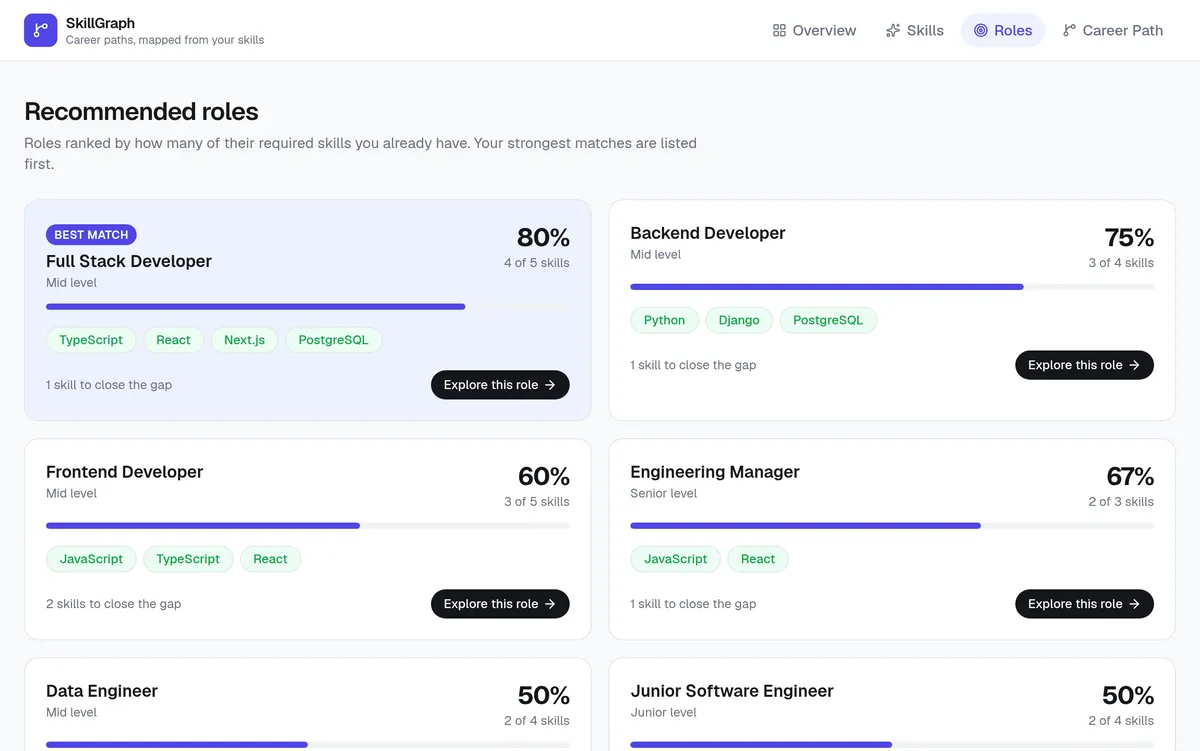
Why a graph
The question SkillGraph answers, "how does this person's work connect to a role they could get next?", is about relationships. A developer has skills, builds projects that use skills, roles require skills, companies offer roles, and skills relate to each other. Answering it means walking across several of those links in one query, which is what a graph database is for.
One modelling choice mattered most: skills a developer claims are kept separate from skills that only show up in projects they built. Project evidence counts as exposure, never silently promoted to a claimed skill.
What I built
- A strict layering: interface, API route, service, query layer, database. Cypher queries live only in the query layer, and every one is parameterised, so user input never becomes query text.
- Seven API routes with validated parameters and errors that don't leak database details.
- An idempotent seed script that uses
MERGE, verified by running it twice against the hosted database and checking that the counts didn't change. - Role matching, skill-gap analysis and a bounded career-path search across related skills, presented as a possible route rather than a promise.
The bug
The role list ranked correctly, but every role's detail page said the developer had 0% of the required skills. The gap query used a pattern-existence check inside a WHERE clause, which is standard openCypher. CognoDB evaluated it as false every time.
I rewrote it as an anti-join using OPTIONAL MATCH and IS NULL, the same pattern the working role list already used, and documented the incompatibility in the README. The lesson I kept: test against the real target database, because a local stand-in won't show you its quirks.
What I'd change
There are no automated tests. In 48 hours I verified by hand against the hosted database; given more time, the query layer would get integration tests first. The hosted demo is not currently online, so I link to the code instead.